Canadian projector buying guide
How to Watch 3D Movies on a Projector in Canada
Watching a 3D movie on a projector requires more than a projector carrying a “3D” label. The content format, playback device, HDMI path, projector input mode and glasses system must all be compatible with one another. If one link in that chain does not match, the result may be an ordinary 2D image, two images side by side, a picture with reversed depth or glasses that never synchronize.

This guide explains how to check the complete chain before buying equipment or planning a movie night. It is specification-based guidance, not a claim that every 3D disc, file, console or pair of glasses works with every projector.
Can any projector show a 3D movie?
No. A projector must explicitly support the 3D signal produced by the source device. The player must be able to output that signal, every device in the HDMI path must pass it correctly, and the glasses must use the synchronization system expected by the projector. A general DLP, 4K or smart-projector label does not establish all of those facts.
Start with the exact movie or file you want to watch. Identify its 3D format and the device that will play it. Then compare that information with the accepted 3D input formats in the projector’s official documentation. Do not begin by buying glasses: glasses cannot make an unsupported source or projector decode 3D.
Check the five-part 3D compatibility chain
1. The content
The media must contain a 3D presentation. A standard 2D stream does not become stereoscopic merely because active glasses are switched on. Disc, broadcast and file-based 3D can use different layouts or timing methods, and a projector may accept some formats but not others.
Streaming catalogues and app support also change by country and provider. Choose a title and Canadian service that explicitly offer a compatible 3D version; ordinary 2D listings remain 2D.
2. The playback device
The player has to recognize the media and output a supported 3D signal. Check the official documentation for the exact Blu-ray player, computer, media box or console model. 3D capabilities vary by model, so matching your exact playback device makes setup easier.
For example, Sony’s official PlayStation 5 FAQ states that PS5 does not support 3D Blu-ray discs. Connecting a PS5 to a 3D-capable projector therefore does not add that missing disc-playback feature. Verify the source instead of assuming that a newer console supports every feature of an older one.
3. The HDMI path
Connect the verified source directly to the projector for the first test. An AV receiver, HDMI switch, splitter, capture device or older cable can become an additional compatibility point. Once direct playback works, add the other components one at a time.
Use the input and cable specification required by the source and projector documentation. A cable working for a 2D menu proves that a picture can pass; it does not by itself prove that the full 3D signal is reaching the projector.
4. The projector mode
The projector must recognize the incoming format or be set to the corresponding 3D mode. Start the compatible content before looking for the mode because some projectors expose or enable 3D controls only when they detect a supported signal. Use the model’s real on-screen labels rather than following a tutorial written for another brand.
If the screen still shows two adjacent or stacked views, stop and recheck the content format and projector mode. Do not guess through unrelated picture settings: brightness, sharpness and keystone do not decode a 3D layout.
5. The glasses
The glasses must match the projector’s system. Active-shutter, DLP-Link, radio-frequency, infrared, polarized and red-and-blue anaglyph glasses are not interchangeable categories. Confirm the required technology before ordering and charge any powered glasses fully before testing.
Active-shutter, DLP-Link and red-and-blue glasses are different
Active-shutter glasses alternately darken the left and right lenses in time with the images intended for each eye. They need power and a compatible synchronization method. DLP-Link is one such method: compatible projectors place synchronization information in the projected light, so viewers normally face the screen rather than the projector.
Not every active-shutter product uses DLP-Link, and a DLP imaging chip alone does not prove that a projector exposes a compatible DLP-Link 3D mode. Match the projector documentation and glasses specification exactly.
Red-and-blue glasses use coloured filters with content prepared as a red/cyan anaglyph image. They contain no powered shutter and do not synchronize with a projector. They can display the intended effect only when the content itself has the required colour-separated image. They are not a low-cost substitute for active-shutter glasses.
Commercial cinemas may use polarized systems with a suitable projector and screen. Bringing cinema glasses home does not make a single home projector reproduce that system. The projection method, screen and glasses must be designed to work together.
What the current BOSS Projectors listings document
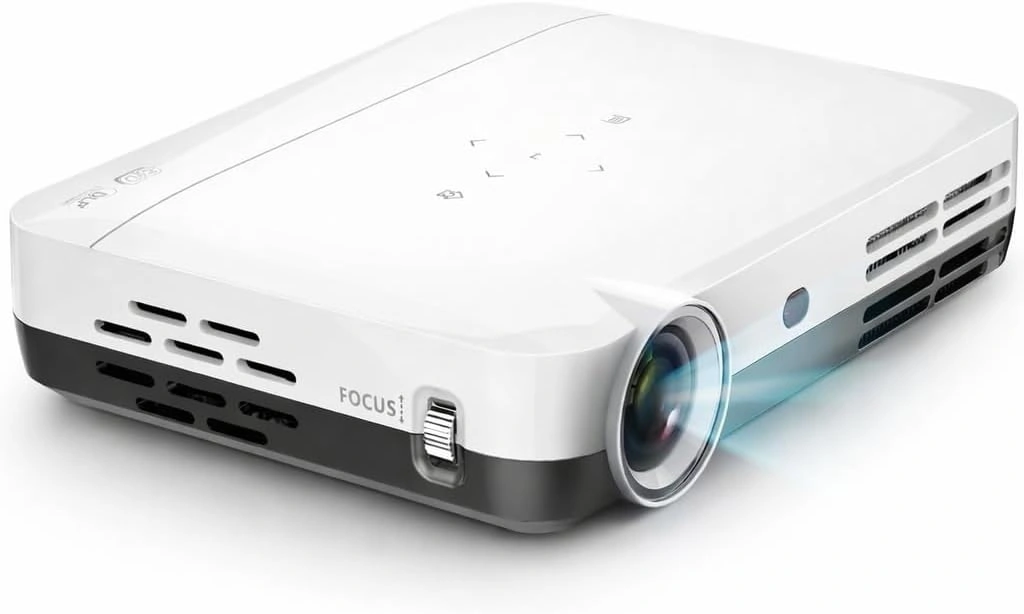
The current BOSS S7 product listing identifies the S7 as a 3840 × 2160 4K UHD DLP/LED hybrid projector with 3D support and describes the compatible accessory as active-shutter DLP-Link glasses. The listing also correctly notes that supported content and the appropriate projector mode are required.
The public BOSS Projectors material available for this review does not publish a complete accepted-format table for side-by-side, top-and-bottom, frame-packed or frame-sequential sources. It would therefore be inaccurate to promise that a particular disc, file or player will work from the phrase “3D support” alone. Before buying specifically for 3D, send BOSS Projectors support the title or file format, the exact player model and every device in the HDMI path, and request confirmation for that combination.
Current direct bundles for the BOSS A5, S6A and S8A may list red-and-blue glasses for compatible anaglyph material, while the S7 bundle may list active-shutter glasses. Those bundle descriptions do not make the two systems interchangeable. Always use the live product page as the source for the current bundle, stock and offer at checkout.
Set up a verified-compatible source
- Charge the active-shutter glasses fully and leave them powered off until compatible content is running.
- Place the projector level and square to a neutral screen or smooth wall, with its ventilation openings clear.
- Connect the verified playback device directly by HDMI for the first test.
- Select the correct projector input and begin the compatible 3D content.
- Enable the matching 3D mode described in the projector documentation.
- Face the screen, power on the glasses and keep the projected-light path unobstructed.
- If depth appears reversed, use a documented left/right or 3D-invert control only if the projector provides one.
Once the direct connection works, reconnect an AV receiver or switch and test again. This sequence makes it clear which component introduces a failure.
Troubleshoot the symptom, not just the glasses
The screen shows two images
A side-by-side or top-and-bottom picture usually means the source is delivering a packed layout that is not being decoded in the active mode. Confirm the exact content layout and choose only a projector mode that the model documentation says supports it. If that format is absent from the accepted-input list, changing glasses will not solve the problem.
The glasses power on but do not synchronize
Recharge them, confirm they use the projector’s required synchronization technology, start supported 3D content and enable the matching mode. For DLP-Link, face the projected image and keep the light path clear. Strong room light, an obstruction or an incompatible format can interfere with a useful test, but avoid claiming that any one of those causes is certain until the complete chain is checked.
The movie remains in 2D
Verify that the chosen version of the movie is actually 3D, that the player outputs 3D and that intermediate HDMI equipment passes it. A projector can display the ordinary 2D menu from an incompatible player while never receiving a 3D signal.
The depth feels backward or uncomfortable
Stop viewing if the image causes discomfort. First confirm the source and format. If the projector documents a left/right reversal setting, test it with a familiar scene. Do not continue watching a visibly incorrect or unstable image merely to finish setup.
Prepare the room for a better 3D test
Control light falling on the screen, begin with a moderate image size and focus every corner before enabling 3D. A larger image spreads the available light over more area, while heavy digital keystone can reduce the usable image and fine detail. Physical alignment gives the compatibility test a clearer baseline.
Keep a stable seating position with a direct view of the screen. Clean the glasses only as their instructions allow, and keep fingerprints off the lenses. If several viewers will watch, test every pair separately because charge level and compatibility can differ even when the frames look similar.
A Canadian 3D-projector buying checklist
- Name the exact 3D movie, disc type or file layout you intend to use.
- Confirm that the exact Canadian content source includes that 3D version.
- Check the playback device’s official 3D output documentation.
- List every receiver, switch or adapter in the HDMI path.
- Obtain the projector’s accepted 3D input formats in writing.
- Match the synchronization technology and glasses, not just the word “active.”
- Treat the live product page as the source for current stock, bundle and price.
- Keep the packaging until the complete source-to-screen chain has been tested under the posted eligible-return policy.
Frequently asked questions
Can any projector play 3D movies?
No. The projector must accept the source’s specific 3D signal, and the player, HDMI path, mode and glasses must all be compatible. A smart-projector, DLP or 4K label alone does not prove that chain.
Are all DLP projectors DLP-Link compatible?
No. DLP describes an imaging technology; DLP-Link support is a model-level feature that must be documented. Confirm the projector’s 3D modes and accepted formats before buying glasses.
Can a PlayStation 5 play 3D Blu-ray movies?
Sony’s official PS5 FAQ states that the console does not support 3D Blu-ray discs. Use a playback device whose documentation confirms support for the media and output format you intend to use.
Are red-and-blue glasses the same as active-shutter glasses?
No. Red-and-blue glasses are passive colour filters for anaglyph content. Active-shutter glasses are powered and require compatible timing and synchronization. Each must be paired with the content and projection system designed for it.
Current models and prices
Explore the current models
Review the key specifications and current prices. Open a model for the full details.